I've talked about nanotechnology before. Here, I'll talk about different products and
technologies that are currently using nanoparticles or nanomaterials, and that
have been improved by this area of science.
10- Fuel additives
Fuel
price is the most important reason why fuel efficiency needs to be improved. Fuel
additives goes in place number 10, because new green energy sources are being
researched at the moment using nanomaterials, which is much better for the
environment in the long run and will be much cheaper.
At the moment, it has been shown that adding cerium oxide
nanoparticles to fuel reduces the amount of fuel used, it also helps
decomposition of unburnt hydrocarbons and soot, and reduces the amount of
pollutants emitted in the exhaust. This technology is currently used in the UK,
for buses.
One disadvantage to the use of nanoparticles in this matter is the
emission of particles to the environment. These particles are likely to
accumulate in the environment, in particular in roadside areas, which will
result in pollution.

9 – Construction
Nanomaterials can be very interesting to the
construction industry, the provide very durable, long-lived and lightweight
construction materials. Very good novel insulation nano-materials are already
available on the market, and they seem to improve energy efficiency. Surface
coatings are also available and being used currently, these coatings promise to
conserve resources, for example water, energy and cleaning agents. Because of
their high prices, the reality is that nano- products are still not very widely
used in the conservative construction industry, which for the time being
prefers to rely on proven, conventional products.
They are mostly used in four sectors, cement-bound construction materials, noise reduction and thermal insulation or temperature regulation, surface coatings to improve the functionality of various materials, and fire protection.
8- Cosmetics – from sunscreen to anti-aging cream
One
very important use of nanomaterials in cosmetics is sunscreens. Titanium
dioxide and zinc dioxide nanoparticles are currently being used in sunscreens
(especially in Australia) to block
UVA and UVB light very efficiently, as well as to make sunscreens less oily and
spread better on the skin without leaving residues.
Another
important use is to deliver active ingredients in anti-aging screens more
easily. Vitamin C, for example, is
an antioxidant used to fight skin damage due to age, which works best below the
top layer of skin. In bulk form, vitamin C is not very stable and is difficult
to penetrate the skin, and the nano form will improve this. Nano emulsions,
which means mixing two
unblendable liquids – like vinegar and
oil, are being used as anti-aging sprays to transport beneficial compounds deep
into the skin and in high concentrations. Nano gold is used in one
moisturiser available in the UK, they allege that it has healing and
anti-oxidant properties.

7- Wound treatment/ antibacterial activity
It
is well known that silver has antibacterial properties and is used for wound
healing and burn treatment. Reducing the size of materials by using
nanoparticles increases the efficiency and improves their properties. So,
incorporating silver nanoparticles into the wound bandages will improve their
healing properties.
Because
of these antibacterial properties, silver nanoparticles are also being used in
many products, like refrigerators, washing machines, air conditioning, toys,
pacifiers, clothing, food storage, etc.
6- Sports
Because of their strength and lightweight, nanoparticles
are being added to sporting goods. Nanomaterials are being used in tennis rackets, which contain carbon nanotubes to
make them extremely strong as well as light, also in golf clubs and shoes. Some
shin-pads for footballers are made with nano-structured plastics. Floyd Landis won the Tour de France on a bicycle which had a
nano-based plastic frame, and now mountain bikes with these frames are
available in the market. Footballs and tennis balls are being improved by using
nano-clays, which are barrier materials and retain pressure.
Clothing and fabrics are also being enhanced by
nanomaterials, from antibacterial socks, using silver nanoparticles, to
waterproof jackets (and sails for boats) and wind resistant clothing that is
breathable – for higher temperatures.

5- Sensors and electronics
One
thing that nanotechnology has been making better is transparent electronics. Highly flexible and transparent electronic
devices will rely on essentially invisible electronic and optoelectronic
circuits. Nanopaper has started to
replace plastic substrates because is lightweight and also low-cost and versatile.This nanopaper, made from cellulose like normal
paper, has a surface that is less rough and has a much higher transparency than
traditional paper. Nanopaper transistors have been made, by Liangbing Hu, an Assistant Professor in the Department of
Materials Science and Engineering at the University of Maryland.
Silicon nanomembranes are also being researched
to make systems that match the mechanics of the epidermis, and take the full
three dimensional shapes of the fingertip as well as other appendages or even
internal organs, like the heart. This technology is known as fingertip
electronics.
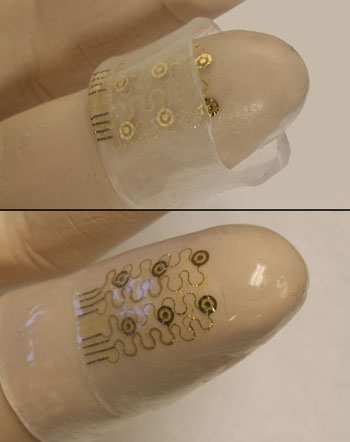
Top: Turning the tube inside out relocates the
array on the inner surface of the finger-tube, shown here at the midway point
of this flipping process. Bottom: Multiplexed array of electrotactile
stimulators in a stretchable, mesh geometry on the inner surface of an
elastomeric finger-tube. (Images: Rogers Group, University of Illinois at
Urbana-Champaign)
Quantum dots and silicon are being used to make LEDS, and a wide range of products, including lamps, displays
and photovoltaics.
4- Environmental clean up
Clean
water is a big concern in many countries in the world, where water sources are
scarce and contaminated. Nanotechnology has proven already to be an inexpensive
and efficient source of water treatment.
It
has been found that magnetic rust
nanoparticles bind to arsenic; the rust and arsenic can then be lifted out of
the water by using only a handheld magnet. Also, iron based nano-filters have
been developed as a low cost alternative to carbon-based filters. Iron filters
can remove large volumes or chlorine and mercury, amongst other contaminants.
3- Technology – microchips
Some of you might not remember bulky and heavy cell phones and big and slow
computers, but some of us do. Nanotechnology has been the key in making machines
smaller with a larger memory. Silicon-based
chips have improved speed and capacity of different devices for the last five
decades. The switches are becoming smaller and smaller, achieving dimensions with
widths of just a few atoms.

Home computer in the 50's

First cellphone

Cellphone evolution
2- Clean energy
To avoid further contamination and reduce energy
prizes it is very important to find new and clean sources of energy.
Nanotechnology has been a big part of finding more efficient and smaller new
energy sources. With very small nanoparticles we can harvest very large amounts
of energy.
In 2013 Nano Letters published "Toward
Large-Scale Energy Harvesting by a Nanoparticle-Enhanced Triboelectric
Nanogenerator", the
researchers found a mechanical energy-harvesting technique – a triboelectric
nanogenerator – which effectively converts ambient mechanical energy into
electrical energy.
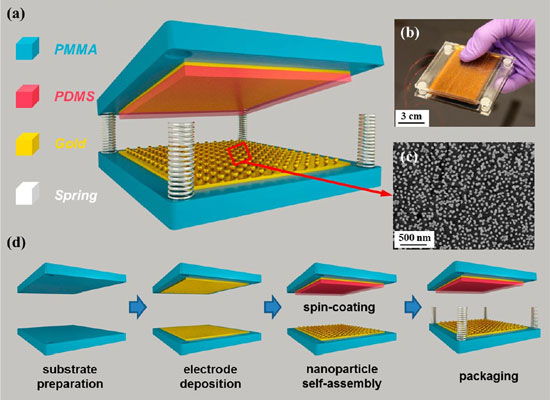
Above, the schematic and (b) photograph of a fabricated
triboelectric nanogenerator. (c) SEM image of gold nanoparticles coated on gold
surface. (d) Process flow for fabricating the nanogenerator. (Reprinted with
permission from American Chemical Society)
Solar cells are also an important source of clean energy, many researchers are investigating the development of flexible solar cells to improve efficiency and lower manufacturing costs. The biggest problem is that inorganic solar cells have an efficiency of more than 10%, while flexible polymer solar cells still show a low efficiency (6 – 7%), this needs to be improved. A review paper in ACS NANO ("Nanoimprinted Polymer Solar Cell") talks about imprinted solar cells, which is a method that could improve the efficiency of both organic and inorganic solar cells.
Solar cells are also an important source of clean energy, many researchers are investigating the development of flexible solar cells to improve efficiency and lower manufacturing costs. The biggest problem is that inorganic solar cells have an efficiency of more than 10%, while flexible polymer solar cells still show a low efficiency (6 – 7%), this needs to be improved. A review paper in ACS NANO ("Nanoimprinted Polymer Solar Cell") talks about imprinted solar cells, which is a method that could improve the efficiency of both organic and inorganic solar cells.
Graphene has also shown great potential in the area of solar cells, which would be inexpensive, lightweight and flexible. Graphene would also improve supercapacitors, lithium-ion batteries, and catalysis for fuel cells.
1.- Medicine - drug delivery
This
has been an area in which nanotechnology has been very important since the
beginning. It is clear that most of the active ingredient of drugs is lost in
the process of the delivery, through pills, injection, etc., with
nanotechnology there has been a constant search to improve the targeting of
organs and improve efficiency.
In March 2013 Researchers at the School of Medicine of
the University of Washington found that
nanoparticles could carry a toxin found in bee venom and were able to destroy
human immunodeficiency virus (HIV) and didn’t harm the surrounding cells. They
plan to develop a vaginal gel
that can be used as a preventive measure to stop the initial infection.

Nanoparticles
(purple) carrying melittin (green) fuse with HIV (small circles with spiked
outer ring), destroying the virus’s protective envelope. Molecular bumpers
(small red ovals) prevent the nanoparticles from harming the body’s normal
cells, which are much larger in size.
Targeted drug delivery can also be achieved by using magnetic nanoparticles are coated with certain biocompatible polymers, coupled with anticancer drugs and later guided by an external magnet to the desired organ.